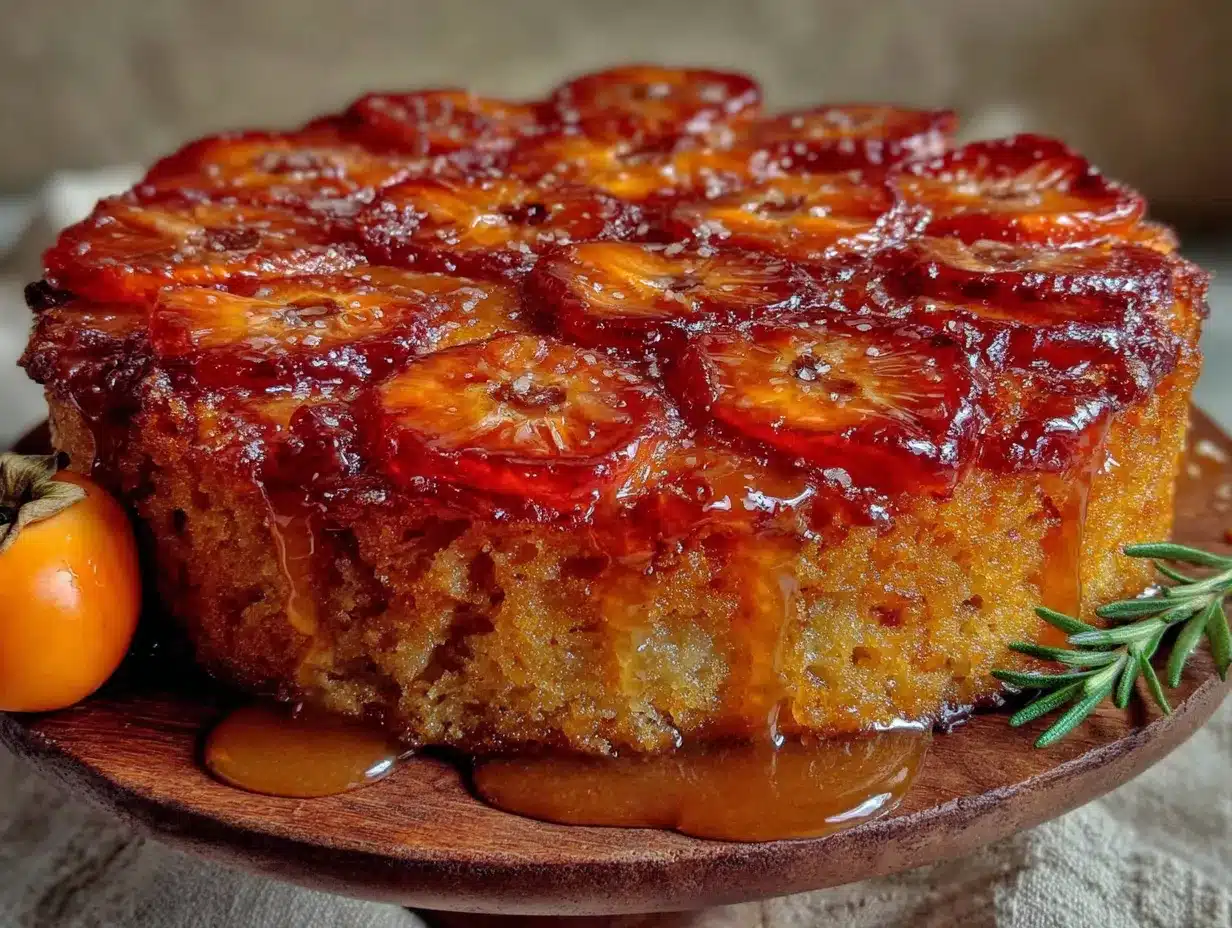
That deep, almost honeyed scent of persimmons melting into butter and brown sugar—the kind that hits you before you even open the oven door—still takes me straight to my grandmother’s tiny kitchen in early November. She wasn’t one for fancy desserts, but every fall, when the persimmons appeared at the farmer’s market, she’d pull out her cast iron skillet and make this sticky, spiced upside-down cake that felt like a secret only we shared. I remember standing on a stool, watching her arrange the fruit slices in perfect concentric circles, her hands moving with the kind of practiced confidence that only comes from decades of cooking by feel.
Honestly, I didn’t appreciate those cakes enough when I was younger. I was too busy wanting chocolate layer cakes and store-bought cookies like the other kids had. But now? Now I get it. There’s something about that combination—the jammy, caramelized persimmons clinging to a tender, warmly spiced cake—that feels like fall in a way that’s hard to put into words. It’s not showy or complicated. It’s just… right.
This sticky spiced persimmon upside-down cake is my grown-up homage to those afternoons in her kitchen. It’s the kind of dessert that makes you slow down, take a deep breath, and remember that the best things in life are often the simplest. And honestly? It’s the only way I’ve ever truly loved persimmons outside of just eating them straight from the tree.
Why You’ll Love This Sticky Spiced Persimmon Upside-Down Cake
Let me tell you why this cake has become my go-to fall dessert, and why I think it’ll become yours too.
- Stunning Without Stress : This cake looks like you spent hours fussing over it, but the upside-down method does all the decorating for you. Just arrange the fruit, pour the batter, and flip—instant showstopper.
- Perfectly Spiced, Not Overpowering : The warm notes of cinnamon, ginger, and a whisper of cardamom complement the persimmons without overwhelming their delicate, honey-like sweetness. It’s balanced, not punchy.
- Uses In-Season Fruit Beautifully : If you’ve ever wondered what to do with a bounty of fall persimmons, this is your answer. They caramelize into something jammy and almost buttery—completely irresistible.
- Moist and Tender for Days : The persimmon puree in the batter keeps this cake incredibly moist. It actually tastes better on day two, if you can wait that long.
- Crowd-Pleaser with a Story : Every time I bring this to a gathering, people ask about it. It’s unique enough to spark conversation but familiar enough to disappear fast.
I’ve tested this recipe at least seven times to get the persimmon-to-cake ratio just right. Too much fruit and the cake gets soggy. Too little and you lose that beautiful sticky top. This version? It’s the Goldilocks of upside-down cakes—and I’m not sorry for how many persimmons I went through to get here.
What Ingredients You Will Need
This recipe relies on simple, wholesome ingredients that come together to create something truly special. Most of these are pantry staples, with the persimmons being the star seasonal player.
For the Sticky Persimmon Topping
- 3-4 ripe but firm Fuyu persimmons (about 450g) — You want them ripe enough to be sweet but firm enough to hold their shape during baking. Hachiya persimmons are too soft and astringent for this application.
- 1/2 cup (113g) unsalted butter — Adds richness and helps create that caramel-like base.
- 3/4 cup (150g) packed light brown sugar — The molasses notes in brown sugar deepen as it bakes, creating that signature sticky, glossy topping.
- 1 teaspoon vanilla extract — Enhances the caramel flavor without competing with the fruit.
- Pinch of salt — Balances the sweetness and brightens the fruit.
For the Spiced Cake Batter
- 1 1/2 cups (190g) all-purpose flour — Spoon and level for accuracy. Too much flour makes the cake dense.
- 1 teaspoon baking powder — For lift and a tender crumb.
- 1/2 teaspoon baking soda — Reacts with the acidity in the persimmon puree for extra tenderness.
- 1/2 teaspoon salt — Don’t skip it; it makes all the flavors sing.
- 1 1/2 teaspoons ground cinnamon — The backbone of the spice blend.
- 1/2 teaspoon ground ginger — Adds warmth without heat.
- 1/4 teaspoon ground cardamom — My secret weapon. It’s floral and slightly citrusy and pairs beautifully with persimmons.
- 1/4 teaspoon ground nutmeg — Freshly grated if you have it.
- 1/2 cup (113g) unsalted butter, softened — Room temperature is crucial for proper creaming.
- 1/2 cup (100g) granulated sugar — Adds sweetness and helps with structure.
- 1/4 cup (50g) packed light brown sugar — Adds moisture and a hint of molasses.
- 2 large eggs, room temperature — Cold eggs can seize the batter.
- 1 cup (about 240g) persimmon puree (from 2-3 very ripe Fuyu persimmons) — This is what keeps the cake incredibly moist. Just blitz peeled, soft persimmons in a food processor until smooth.
- 1/2 cup (120ml) buttermilk, room temperature — The acidity tenderizes the gluten, resulting in a soft, fine crumb. No buttermilk? Add 1/2 tablespoon lemon juice to regular milk and let it sit for 5 minutes.
- 1 teaspoon vanilla extract — Rounding out the flavor profile.
For the persimmon puree, I’ve found that the soft, almost squishy Fuyu persimmons work best. The ones that are just past their prime for eating out of hand are perfect here. I’ve used both homemade persimmon puree and store-bought when I’m in a pinch, and honestly, homemade is noticeably better in flavor and texture.
Equipment Needed
You don’t need a lot of fancy tools for this one, which is part of its charm.
- 9-inch cast iron skillet — This is ideal because it goes from stovetop to oven beautifully. If you don’t have one, a 9-inch round cake pan will work, but you’ll need to melt the butter and sugar topping on the stovetop first and pour it into the pan.
- Electric hand mixer or stand mixer — For creaming the butter and sugar properly. You can do it by hand with a whisk and some elbow grease, but a mixer makes it easier to get that light, fluffy texture.
- Mixing bowls — One large, one medium.
- Whisk — For combining dry ingredients.
- Rubber spatula — For folding the batter and scraping every last bit.
- Sharp knife and cutting board — For slicing the persimmons evenly.
- Food processor or blender — For making the persimmon puree. A fork works if you mash very ripe fruit thoroughly.
- Cooling rack — Essential for the all-important flip.
- Serving plate — Make sure it’s larger than the skillet or pan, with a slight lip to catch any sticky drips.
I’ve made this cake in a regular 9-inch round cake pan when my cast iron was otherwise occupied, and it worked fine. Just note that the caramel topping won’t be quite as deeply browned since you’re not starting it on the stovetop. If you bake a lot of upside-down cakes, a cast iron skillet is worth the investment—it’s also perfect for making peach cobbler in the summer.
Preparation Method
Let’s walk through this step by step. I’ll include all the little details I’ve learned the hard way.
Step 1: Prepare the Persimmons
Preheat your oven to 350°F (175°C). Peel the Fuyu persimmons using a vegetable peeler—the skin is thin but can be tough after baking. Slice them crosswise into 1/4-inch (6mm) thick rounds. You should get about 4-5 slices per persimmon, depending on size. Set the prettiest slices aside for the topping. Take the less uniform slices, any scraps, and 2-3 extra soft persimmons, and blitz them in a food processor until smooth to make your 1 cup of puree. Set that aside too.
Step 2: Make the Sticky Topping
Place your 9-inch cast iron skillet over medium heat. Add the 1/2 cup of butter and let it melt completely. Sprinkle the 3/4 cup of brown sugar evenly over the melted butter. Stir gently with a wooden spoon until the sugar is mostly dissolved and the mixture is bubbling, about 2-3 minutes. Remove from heat and stir in the vanilla and a pinch of salt. Don’t walk away during this step—burnt sugar topping is a tragedy I’ve experienced firsthand.
Step 3: Arrange the Persimmon Slices
Now for the fun part. Starting from the center of the skillet, arrange your persimmon slices in concentric circles, overlapping them slightly. I like to place one perfect slice right in the middle, then work my way outward. Don’t stress about perfection—the cake will look beautiful no matter what. Just make sure the fruit covers the entire bottom of the skillet in a single layer. Press them down gently into the warm sugar mixture.
Step 4: Mix the Dry Ingredients
In a medium bowl, whisk together the flour, baking powder, baking soda, salt, cinnamon, ginger, cardamom, and nutmeg. Set aside. This step ensures your spices are evenly distributed throughout the cake—no one wants a bite with a pocket of pure cardamom.
Step 5: Cream the Butter and Sugars
In a large mixing bowl, beat the softened 1/2 cup butter, granulated sugar, and brown sugar together with an electric mixer on medium speed until light and fluffy, about 3-4 minutes. Scrape down the sides of the bowl halfway through. The mixture should look pale and airy. This step is crucial for a tender cake, so don’t rush it.
Step 6: Add the Eggs and Persimmon Puree
Add the eggs one at a time, beating well after each addition until fully incorporated. The batter might look slightly curdled at this point—that’s okay. Beat in the persimmon puree and vanilla extract until smooth. The batter will look a little looser than a standard cake batter because of all that moisture, but trust the process.
Step 7: Alternate the Dry Ingredients and Buttermilk
With the mixer on low speed, add about one-third of the flour mixture to the butter mixture, mixing just until combined. Add half of the buttermilk and mix briefly. Repeat with another third of the flour, the remaining buttermilk, and finally the last of the flour. Mix just until you no longer see streaks of flour. Overmixing at this stage will develop too much gluten and make the cake tough. Use a rubber spatula to give the batter a few gentle folds from the bottom up, ensuring everything is incorporated.
Step 8: Assemble and Bake
Gently spoon the batter over the arranged persimmon slices in the skillet. Use an offset spatula or the back of a spoon to spread it evenly, being careful not to disturb the fruit. The batter will be thick. Bake for 40-45 minutes, or until a wooden skewer inserted into the center of the cake (not through the fruit layer) comes out clean or with a few moist crumbs. The top should be golden brown and spring back when lightly touched.
Step 9: The Flip
This is the moment of truth. Let the cake cool in the skillet for exactly 10 minutes on a wire rack. Don’t let it cool longer than that, or the sticky topping will harden and the cake will stick to the pan. Place your serving plate upside down over the skillet. Wearing oven mitts, carefully invert the skillet and plate together in one confident motion. Lift the skillet off slowly. If any persimmon slices stick to the skillet, just nudge them back into place on the cake with a small spatula. Let the cake cool completely before slicing, at least 1 hour. The flavors need time to settle.
Cooking Tips & Techniques
I’ve made this cake enough times to know where things can go sideways. Here’s what I’ve learned.
Don’t skip the persimmon puree. I tried making this once without it, thinking the sliced fruit on top would be enough moisture. It wasn’t. The puree is what gives this cake its incredibly tender, almost pudding-like crumb. It’s non-negotiable.
Watch the flip timing like a hawk. I learned this the hard way when I got distracted by a phone call and let the cake cool for 20 minutes instead of 10. The caramel had set so firmly that half the fruit stayed glued to the skillet. Ten minutes is the sweet spot—the cake is stable enough to hold its shape, but the topping is still warm and loose.
Use room temperature ingredients. Cold eggs or buttermilk will seize the creamed butter, leaving you with a dense, uneven crumb. Take everything out of the fridge 30 minutes before you start baking. Your cake will thank you.
Measure your flour correctly. Spoon it into your measuring cup and level it off with a knife. Scooping directly from the bag can pack in up to 25% more flour, resulting in a dry, heavy cake. I speak from experience—my first attempt was a sad, crumbly disc.
If the top is browning too fast. Tent the cake loosely with aluminum foil during the last 10-15 minutes of baking. Every oven runs a little differently, and some will brown the top before the center is fully baked.
For cleaner slices, use a sharp serrated knife and wipe it clean between cuts. The sticky topping can drag and make a mess of your beautiful layers.
Variations & Adaptations
This cake is wonderfully adaptable. Here are a few ways I’ve played with it.
Spice it up differently. Swap the cardamom for 1/4 teaspoon of allspice or cloves for a deeper, more traditional fall flavor. I’ve also made a version with 1/2 teaspoon of Chinese five-spice powder, and it was surprisingly lovely with the persimmons.
Add some crunch. Sprinkle 1/4 cup of chopped pecans or walnuts over the brown sugar mixture before arranging the persimmon slices. The nuts toast in the caramel and add a wonderful textural contrast to the soft cake and fruit.
Make it gluten-free. Substitute the all-purpose flour with a good 1:1 gluten-free baking flour blend that contains xanthan gum. I’ve used King Arthur’s Measure for Measure with excellent results. The texture will be slightly more delicate, but still delicious.
Try a different fruit. While persimmons are the star here, this method works beautifully with other firm fall fruits. Sliced pears or apples are fantastic substitutes. Just adjust the baking time slightly—apples may need an extra 5 minutes, while ripe pears might need 5 minutes less.
Dairy-free version. Use vegan butter and replace the buttermilk with 1/2 cup of unsweetened oat milk mixed with 1/2 tablespoon of lemon juice. The cake will be slightly less rich but still absolutely wonderful.
I once made a version with thinly sliced fresh figs layered in with the persimmons, and it was a gorgeous, jewel-toned masterpiece. If you have access to fresh figs, try it—the combination is incredible.
Serving & Storage Suggestions
This cake is best served at room temperature, which lets the sticky topping soften to that perfect, spoonable consistency. A dollop of lightly sweetened whipped cream or a scoop of vanilla bean ice cream is the classic accompaniment, and for good reason—the cold creaminess balances the warm spices beautifully.
For a more grown-up presentation, drizzle each slice with a little warm salted caramel sauce and a sprinkle of flaky sea salt. The contrast of sweet, salty, and sticky is absolutely addictive.
Storage: Cover the cake tightly with plastic wrap or store it in an airtight container at room temperature for up to 3 days. Do not refrigerate it—the cold will dry out the cake and make the topping grainy. If your kitchen is very warm, you can refrigerate it, but let slices come to room temperature before serving.
Freezing: This cake freezes beautifully. Wrap the completely cooled cake (still in the skillet or on the plate) in a layer of plastic wrap, then a layer of aluminum foil. Freeze for up to 3 months. Thaw overnight in the refrigerator, then bring to room temperature before serving. The topping will soften as it thaws.
Reheating: If you want that just-baked warmth, pop individual slices in a 300°F (150°C) oven for 5-7 minutes, or microwave for 15-20 seconds. The microwave is faster, but the oven keeps the texture more intact.
The flavors actually deepen and meld overnight. I often make this cake a day ahead of when I plan to serve it, and it’s always even better the next day. The spices have time to settle into the crumb, and the persimmon topping becomes even more jammy and concentrated.
Nutritional Information & Benefits
Let’s be real—this is a butter-and-sugar cake, and I’m not going to pretend it’s health food. But it does have some redeeming qualities worth mentioning.
Estimated per serving (1/12 of cake): Calories: 345, Fat: 18g, Carbohydrates: 45g, Fiber: 2g, Sugar: 28g, Protein: 4g.
Persimmons are a nutritional powerhouse. They’re loaded with vitamin A (great for eye health), vitamin C (immune support), and manganese. They also contain powerful antioxidants like beta-carotene and lycopene, which help fight inflammation. So while you’re enjoying that sticky, buttery cake, you’re also getting a solid dose of fall’s best nutrients.
Dietary considerations: This recipe contains dairy, eggs, and gluten. See the variations section above for gluten-free and dairy-free adaptations. It’s naturally nut-free if you skip the optional pecan topping. For a lower-sugar version, you can reduce the brown sugar in the topping to 1/2 cup and the granulated sugar in the batter to 1/3 cup, but the texture and caramelization will be slightly different.
I personally love that this cake lets the fruit shine. It’s not buried under mountains of frosting or artificial flavors. It’s honest, seasonal baking at its finest.
Conclusion
This sticky spiced persimmon upside-down cake is more than just a dessert to me. It’s a memory of my grandmother’s kitchen, a celebration of fall’s fleeting bounty, and proof that the simplest ingredients can create something truly memorable. The way the persimmons caramelize into a jammy, almost honey-like topping, the warmth of the spices, the tender, moist crumb—it all comes together in a way that feels both nostalgic and fresh.
I hope you’ll give this recipe a try, whether you’re a persimmon lover or someone who’s never quite known what to do with them. Don’t be afraid to make it your own—swap the spices, add some nuts, or experiment with different fruits. That’s the beauty of baking. And when you flip that skillet and see those beautiful, sticky persimmon slices glistening on top of your cake, I promise you’ll feel a little rush of joy.
If you make this cake, I’d love to hear about it. Leave a comment below, tag me in your photos, or tell me about your own fall baking traditions. Happy baking, friends!
Frequently Asked Questions
Can I use Hachiya persimmons instead of Fuyu?
No, I wouldn’t recommend it. Hachiya persimmons are astringent and incredibly tart until they’re fully, almost mushy ripe. Even then, they don’t hold their shape well for slicing. Stick with Fuyu persimmons, which are sweet and firm even when ripe. If all you have are Hachiyas, you can use them to make the persimmon puree for the batter, but use Fuyu slices for the topping.
Why did my cake stick to the skillet?
This usually happens for one of two reasons: you let the cake cool too long before flipping (stick to the 10-minute rule), or your skillet wasn’t properly seasoned or greased. Even with the butter and sugar mixture, a well-seasoned cast iron skillet makes the flip much smoother. If you’re using a regular cake pan, make sure to grease it well with butter or non-stick spray before adding the topping mixture.
Can I make this cake ahead of time?
Absolutely. In fact, I prefer it. The flavors meld and deepen overnight, and the texture becomes even more moist and tender. Just cool the cake completely, cover it tightly, and store it at room temperature for up to 3 days. Don’t refrigerate it, as the cold will dry out the cake and make the topping grainy.
What if I don’t have buttermilk?
No problem at all. You can make a quick buttermilk substitute by adding 1/2 tablespoon of lemon juice or white vinegar to 1/2 cup of regular milk. Let it sit for 5 minutes, and you’ll have a perfectly good buttermilk replacement. The acidity is what matters for tenderizing the gluten and activating the baking soda.
Can I freeze this cake?
Yes, and it freezes beautifully. Wrap the completely cooled cake (still on the serving plate) in a layer of plastic wrap, then a layer of aluminum foil. Freeze for up to 3 months. To serve, thaw overnight in the refrigerator, then bring to room temperature before slicing. The sticky topping will soften perfectly as it thaws.
Pin This Recipe!
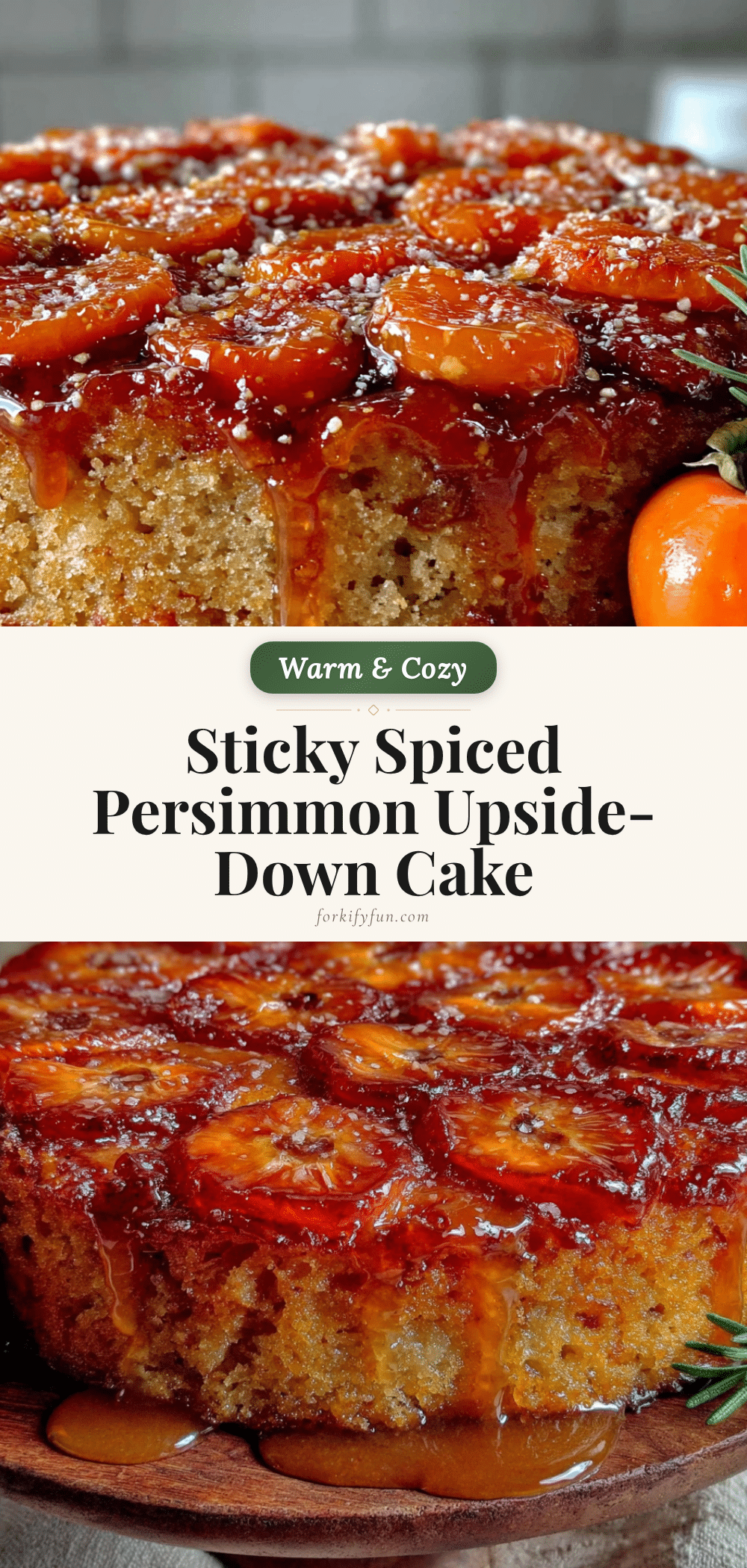
Easy Sticky Spiced Persimmon Upside-Down Cake Recipe
A nostalgic fall dessert featuring caramelized Fuyu persimmons atop a tender, warmly spiced cake. This upside-down cake is simple to make yet stunning, with a moist crumb and jammy fruit topping that tastes even better the next day.
- Prep Time: 20 minutes
- Cook Time: 45 minutes
- Total Time: 1 hour 5 minutes
- Yield: 12 servings 1x
- Category: Dessert
- Cuisine: American
Ingredients
- 3–4 ripe but firm Fuyu persimmons (about 450g)
- 1/2 cup (113g) unsalted butter
- 3/4 cup (150g) packed light brown sugar
- 1 teaspoon vanilla extract
- Pinch of salt
- 1 1/2 cups (190g) all-purpose flour
- 1 teaspoon baking powder
- 1/2 teaspoon baking soda
- 1/2 teaspoon salt
- 1 1/2 teaspoons ground cinnamon
- 1/2 teaspoon ground ginger
- 1/4 teaspoon ground cardamom
- 1/4 teaspoon ground nutmeg
- 1/2 cup (113g) unsalted butter, softened
- 1/2 cup (100g) granulated sugar
- 1/4 cup (50g) packed light brown sugar
- 2 large eggs, room temperature
- 1 cup (about 240g) persimmon puree (from 2–3 very ripe Fuyu persimmons)
- 1/2 cup (120ml) buttermilk, room temperature
- 1 teaspoon vanilla extract
Instructions
- Preheat oven to 350°F (175°C). Peel Fuyu persimmons and slice crosswise into 1/4-inch (6mm) rounds. Set prettiest slices aside for topping. Blitz less uniform slices and extra soft persimmons in a food processor to make 1 cup of puree.
- Place a 9-inch cast iron skillet over medium heat. Melt 1/2 cup butter, then sprinkle 3/4 cup brown sugar evenly over it. Stir until sugar is mostly dissolved and bubbling, about 2-3 minutes. Remove from heat and stir in vanilla and a pinch of salt.
- Arrange persimmon slices in concentric circles over the sugar mixture, overlapping slightly. Press gently into the warm sugar.
- In a medium bowl, whisk together flour, baking powder, baking soda, salt, cinnamon, ginger, cardamom, and nutmeg.
- In a large bowl, beat softened 1/2 cup butter, granulated sugar, and 1/4 cup brown sugar with an electric mixer on medium speed until light and fluffy, about 3-4 minutes.
- Add eggs one at a time, beating well after each. Beat in persimmon puree and 1 teaspoon vanilla until smooth.
- With mixer on low, add one-third of the flour mixture, mixing just until combined. Add half the buttermilk, mix briefly. Repeat with another third of flour, remaining buttermilk, and last of flour. Mix just until no streaks remain. Fold gently with a rubber spatula.
- Spoon batter over persimmon slices in skillet, spreading evenly. Bake for 40-45 minutes, until a skewer inserted into the center (not through fruit) comes out clean or with a few moist crumbs.
- Cool in skillet on a wire rack for exactly 10 minutes. Place serving plate upside down over skillet, invert confidently, and lift skillet off. Nudge any stuck fruit back into place. Cool completely before slicing, at least 1 hour.
Notes
Don’t skip the persimmon puree—it keeps the cake moist. Watch the flip timing: exactly 10 minutes cooling, or the caramel will harden. Use room temperature ingredients for best texture. Measure flour by spooning and leveling. If top browns too fast, tent with foil during last 10-15 minutes. For cleaner slices, use a serrated knife wiped clean between cuts.
Nutrition
- Serving Size: 1 slice (1/12 of cak
- Calories: 345
- Sugar: 28
- Sodium: 280
- Fat: 18
- Saturated Fat: 11
- Carbohydrates: 45
- Fiber: 2
- Protein: 4
Keywords: persimmon upside-down cake, fall dessert, spiced cake, sticky cake, cast iron skillet cake, persimmon recipe