My neighbor Sarah asked me why I couldn’t just use store-bought bread cubes for stuffing. I started to explain why that wouldn’t work—then stopped. Honestly, I had no good answer. I’d been making stuffing from scratch for years, tearing up day-old artisan loaves, convinced that anything from a bag was a shortcut too far. But Sarah was in a hurry, her kids were hungry, and she just wanted dinner on the table. So I tried it her way.
The result? A total surprise. The bread cubes soaked up the broth beautifully, but something was missing—that chewy, tangy bite you get from real bread. So we compromised. I grabbed a leftover loaf of sourdough focaccia from my fridge (the one I’d been too tired to finish), cubed it up, and threw it in a pan with butter and sage. Let me tell you, the moment that butter hit the hot pan, I knew we were onto something special.
That’s how this quick sourdough focaccia stuffing with sage and butter was born—out of a weeknight scramble and a neighbor’s no-nonsense suggestion. I was the one who learned something that day. Sometimes the best recipes come from letting go of your rules and listening to someone who just wants to get dinner done. This one’s for all of us who love good food but don’t have all day to make it happen.
Why You’ll Love This Recipe
Let me be real with you—I’ve tested this recipe six times now, and each time it gets better. This isn’t just another stuffing recipe. It’s the one that saves your weeknight dinner without sacrificing flavor.
- Quick & Easy : Comes together in under 40 minutes, start to finish. No overnight drying of bread, no complicated steps.
- Simple Ingredients : You probably have most of this already. Butter, sage, onion, celery, broth—and that leftover focaccia you were going to toss.
- Perfect for Weeknights : This isn’t just a holiday dish. It’s hearty enough for a Tuesday dinner alongside roast chicken or pork chops.
- Crowd-Pleaser : My kids fought over the crispy bits on top. My husband asked for leftovers for lunch the next day.
- Unbelievably Delicious : The sourdough focaccia brings this tangy chewiness that regular bread just can’t match. Plus, that golden, buttery crust? Forget about it.
What makes this recipe different is the bread itself. Sourdough focaccia has this naturally airy crumb with a sturdy crust that holds up beautifully to broth without turning into mush. The tang from the sourdough cuts through the richness of the butter, creating this perfect balance that keeps you coming back for another forkful.
This is comfort food you can actually make on a busy night. It’s the kind of dish that makes you close your eyes after the first bite—not because it’s fancy, but because it tastes like someone took the time to make something good, even when they didn’t have much time at all.
What Ingredients You Will Need
This recipe uses simple, everyday ingredients that work together to create something truly special. Most of these are pantry staples or fridge basics you probably already have on hand.
- Sourdough focaccia (about 1 pound, cut into 1-inch cubes) — Day-old is ideal, but fresh works too. I like the tangy flavor from a bakery-style loaf. If you don’t have focaccia, a crusty sourdough boule works in a pinch.
- Unsalted butter (6 tablespoons, divided) — Use good quality butter here since it’s a star ingredient. I prefer Kerrygold for its rich flavor.
- Fresh sage leaves (2 tablespoons, chopped) — Don’t even think about using dried sage here. Fresh makes all the difference. Look for leaves that are bright green and fragrant.
- Yellow onion (1 medium, diced) — About 1 cup. Sweet onions work too if that’s what you have.
- Celery stalks (3, diced) — About 1 cup. This adds that classic stuffing crunch.
- Garlic cloves (3, minced) — Fresh garlic only. The jarred stuff won’t give you the same punch.
- Low-sodium chicken or vegetable broth (1 ½ cups) — Homemade is great, but store-bought works fine. I use Swanson low-sodium chicken broth most of the time.
- Large eggs (2, lightly beaten) — These help bind everything together. Let them come to room temperature first for best results.
- Kosher salt (1 teaspoon) — I use Diamond Crystal. If using table salt, reduce to ½ teaspoon.
- Black pepper (½ teaspoon, freshly ground) — Freshly ground really does taste better here.
- Fresh parsley (2 tablespoons, chopped, for garnish) — Optional, but adds a nice pop of color and freshness.
Substitution Notes: If you need this dairy-free, use a good vegan butter like Miyoko’s. For gluten-free, look for a gluten-free sourdough focaccia—there are some good options at specialty bakeries. You can swap the sage for rosemary or thyme if that’s what you have growing in your garden. And if you’re out of fresh herbs altogether, use 1 teaspoon of dried sage plus 1 teaspoon of dried thyme—just add them to the butter when you cook the onions.
Equipment Needed
You don’t need much for this recipe, which is exactly how I like it on a busy night. Here’s what you’ll need:
- Large baking dish (9×13-inch works perfectly) — A ceramic or glass dish gives you even browning. Metal works too, just keep an eye on the bottom so it doesn’t get too dark.
- Large skillet (12-inch) — For cooking the onions, celery, and garlic. A nonstick skillet makes cleanup easier, but stainless steel works fine.
- Large mixing bowl — For combining all the ingredients. Any big bowl will do.
- Chef’s knife and cutting board — A sharp knife makes dicing the onions and celery so much faster.
- Measuring cups and spoons — For accurate measurements. I’ve learned the hard way that eyeballing broth leads to soggy stuffing.
- Whisk — For beating the eggs. A fork works in a pinch.
- Spatula or wooden spoon — For stirring everything together.
- Aluminum foil — For covering the dish during the first part of baking.
If you don’t have a 9×13 dish, you can use a 10-inch cast iron skillet or even a 9-inch square baking dish—just adjust the baking time by about 5 minutes. And honestly, I’ve made this in a disposable aluminum pan before and it turned out just fine. Don’t let equipment stop you from making dinner.
Preparation Method

Let me walk you through this step by step. I promise it’s easier than it sounds.
-
Preheat your oven to 375°F (190°C). Position a rack in the middle of the oven. While it’s heating, grab your 9×13 baking dish and set it aside.
-
Toast the focaccia cubes. Spread the bread cubes in a single layer on a baking sheet. Bake for 8-10 minutes, until they’re lightly golden and dry to the touch. Don’t skip this step—it keeps the stuffing from turning into a soggy mess. You want them dry but not hard. Set aside to cool while you prep the vegetables.
-
Melt 4 tablespoons of butter in your large skillet over medium heat. Add the diced onion and celery. Cook for 6-8 minutes, stirring occasionally, until the onions are translucent and the celery has softened. You’ll know it’s ready when your kitchen starts smelling like Sunday dinner.
-
Add the minced garlic and chopped sage to the skillet. Cook for 1 more minute, just until the garlic is fragrant. Don’t let it brown or it’ll turn bitter. Stir constantly during this step.
-
Transfer the vegetable mixture to your large mixing bowl. Add the toasted focaccia cubes and toss gently to combine. The bread should be evenly coated with the buttery vegetables.
-
In a separate small bowl or measuring cup, whisk together the chicken broth, beaten eggs, salt, and pepper. Pour this mixture over the bread and vegetables. Use your spatula to fold everything together gently—you want the bread to absorb the liquid without breaking apart.
-
Let the mixture sit for 5-10 minutes. This gives the bread time to soak up all that flavorful broth. Give it a gentle stir halfway through. The cubes should be moist but not swimming in liquid.
-
Transfer the stuffing to your prepared baking dish and spread it into an even layer. Don’t press it down too firmly—you want some texture and air pockets for those crispy bits.
-
Melt the remaining 2 tablespoons of butter and drizzle it over the top of the stuffing. This is what gives you that gorgeous golden crust.
-
Cover the dish with aluminum foil and bake for 20 minutes. Then remove the foil and bake for another 15-20 minutes, until the top is golden brown and crispy around the edges. The internal temperature should reach 165°F (74°C) if you want to be precise.
-
Let it rest for 5 minutes before serving. This helps the stuffing set so it holds its shape when you scoop it out. Sprinkle with fresh parsley right before serving.
Pro tip: If you’re in a hurry, you can skip the toasting step and use day-old focaccia that’s already a bit stale. Just reduce the broth to 1 cup since the bread won’t absorb as much liquid. I’ve done this on nights when I forgot to plan ahead, and it still came out delicious.
Cooking Tips & Techniques
After making this recipe more times than I care to count, I’ve picked up a few tricks that make a real difference.
Don’t overmix the stuffing. I learned this the hard way when I made a batch that turned into paste. You want to fold gently, just until everything is combined. The bread cubes should still be recognizable pieces, not mush.
Toast your bread cubes even if they seem dry. I know it feels like an extra step, but it’s the difference between stuffing that holds its texture and stuffing that collapses into a sad, soggy heap. The toasting creates a barrier that helps the bread absorb liquid slowly rather than all at once.
Watch your liquid ratio. Different breads absorb different amounts of liquid. Sourdough focaccia is pretty sturdy, so it can handle more broth than a soft sandwich bread. Start with 1 ¼ cups of broth, and add more only if the mixture looks dry after sitting for 5 minutes. The mixture should look moist but not wet—think damp sponge, not soaked towel.
Let it rest before serving. I know you’re hungry, but those 5 minutes of resting time are crucial. The stuffing continues to set as it cools slightly, and the flavors meld together. Plus, you won’t burn your mouth on the first bite.
Make it ahead of time. You can assemble the entire dish (without the final butter drizzle) up to 24 hours in advance. Just cover and refrigerate. When you’re ready to bake, add the butter drizzle and add about 10 minutes to the covered baking time. This is a lifesaver on busy weeknights.
One mistake I still make: I sometimes forget to check the salt level of my broth. If you’re using a salted broth, reduce the added salt to ½ teaspoon. Taste the broth mixture before pouring it over the bread—if it tastes seasoned, you’re good.
Variations & Adaptations
This recipe is flexible, and I love playing around with different versions depending on what I have in the fridge.
Herb Lover’s Version: Add 1 tablespoon each of fresh rosemary and thyme along with the sage. The earthy herbs pair beautifully with the tangy sourdough. I made this for Thanksgiving last year and my aunt asked for the recipe twice.
Sausage and Apple Stuffing: Brown ½ pound of Italian sausage (casings removed) in the skillet before cooking the vegetables. Add 1 diced apple (I like Honeycrisp) along with the onions. The sweetness of the apple and the savory sausage take this in a completely different direction—perfect for fall dinners.
Mushroom and Leek Version: Swap the celery for 8 ounces of sliced cremini mushrooms and 1 large leek (white and light green parts only, cleaned well). Cook the mushrooms until they release their liquid and start to brown, then add the leek. This version feels more elegant, like something you’d serve at a dinner party.
Dairy-Free Adaptation: Use a high-quality vegan butter and make sure your broth is vegetable-based. I’ve tested this with Miyoko’s European Style Cultured Vegan Butter and it worked beautifully—the top still got golden and crispy.
Gluten-Free Option: Look for a gluten-free sourdough focaccia from a local bakery or make your own. The key is to find one with a sturdy crumb that won’t fall apart. I’ve used Against the Grain’s gluten-free baguette in a pinch (just cube it up) and it worked surprisingly well.
Extra-Crispy Top: If you’re like me and love those crunchy bits, broil the stuffing for 1-2 minutes at the end. Watch it carefully—it goes from golden to burnt fast. I learned this after setting off the smoke detector at 11 PM on a Tuesday.
Serving & Storage Suggestions
This stuffing is best served warm, straight from the oven. Spoon it onto plates alongside roast chicken, pork chops, or a simple green salad. The crispy top pieces are the most popular—I always make sure to get some of those in my serving.
For a complete weeknight meal, I’ll serve this with a quick roasted chicken and steamed green beans. The stuffing is hearty enough that you don’t need much else. Leftovers are fantastic the next day—the flavors meld together overnight and get even better.
Storage: Let the stuffing cool completely, then transfer to an airtight container. It will keep in the refrigerator for up to 4 days. The texture softens a bit, but the flavor is still wonderful.
Freezing: You can freeze the baked stuffing for up to 3 months. Wrap the dish tightly in plastic wrap, then aluminum foil. To reheat, thaw overnight in the refrigerator, then bake at 350°F (175°C) for 20-25 minutes, covered, until heated through. Add a splash of broth if it seems dry.
Reheating: The oven is your best bet for restoring some of that crispy texture. Reheat at 350°F (175°C) for about 15 minutes, uncovered. The microwave works in a pinch but the top won’t be crispy. If you’re in a hurry, I’ve been known to reheat individual servings in a skillet with a pat of butter—it crisps up the bottom beautifully.
One thing I love about this recipe is that the flavors actually improve after a day in the fridge. The sage and butter really sink into the bread, and the tang from the sourdough becomes more pronounced. Don’t be afraid to make extra on purpose.
Nutritional Information & Benefits
Here’s the nutritional breakdown for one serving (about 1 cup, based on 8 servings):
| Nutrient | Amount per Serving |
|---|---|
| Calories | 285 |
| Total Fat | 14g |
| Saturated Fat | 8g |
| Cholesterol | 75mg |
| Sodium | 520mg |
| Total Carbohydrates | 32g |
| Dietary Fiber | 2g |
| Sugars | 3g |
| Protein | 7g |
Sourdough bread has some surprising benefits. The fermentation process breaks down phytic acid, making nutrients like magnesium and zinc more available to your body. It also has a lower glycemic index than regular bread, which means it won’t spike your blood sugar as much.
Sage isn’t just for flavor—it’s been used for centuries in traditional medicine. It’s rich in antioxidants and has anti-inflammatory properties. Plus, that beautiful green color means it’s packed with vitamin K.
Dietary Considerations: This recipe contains gluten, dairy, and eggs. For a dairy-free version, use vegan butter. For gluten-free, use a gluten-free sourdough focaccia. The recipe is vegetarian if you use vegetable broth. It’s not suitable for vegan diets unless you use an egg substitute and vegan butter, though I haven’t tested that version myself.
I’m not a nutritionist, but I do believe that food made with real ingredients—butter, fresh herbs, good bread—is better for you than anything that comes from a box. This stuffing is comfort food you can feel good about eating.
Conclusion
This quick sourdough focaccia stuffing with sage and butter has become a staple in my kitchen, and I think it will in yours too. It’s proof that you don’t need hours in the kitchen or a special occasion to make something truly delicious. Sometimes the best recipes come from a tired cook, a helpful neighbor, and a willingness to try something different.
I love that this recipe respects your time without skimping on flavor. The tangy sourdough, the rich butter, the aromatic sage—every bite tastes intentional. Whether you’re making this for a holiday dinner or just a regular Tuesday, it delivers that warm, comforting feeling we all need sometimes.
I’d love to hear how it turns out for you. Did you try one of the variations? Discover a new trick? Drop a comment below and let me know—I read every single one. And if you’re looking for more weeknight-friendly recipes, check out my quick herb roasted chicken or easy garlic green beans—they pair perfectly with this stuffing.
Happy cooking, and remember: sometimes the best things happen when you let go of the rules and just make dinner.
Frequently Asked Questions
Can I use regular bread instead of sourdough focaccia?
You can, but the texture and flavor won’t be the same. Sourdough focaccia has a chewy crumb and tangy flavor that regular bread can’t replicate. If you must substitute, use a crusty sourdough boule or ciabatta.
Do I have to toast the bread cubes first?
Yes, I really recommend it. Toasting dries out the bread so it can absorb the broth without turning into mush. Skipping this step leads to soggy stuffing, and nobody wants that.
Can I make this stuffing ahead of time?
Absolutely. Assemble the dish (without the final butter drizzle) up to 24 hours in advance and refrigerate. Add the butter just before baking, and add about 10 minutes to the covered baking time.
How do I get the top extra crispy?
After baking, switch your oven to broil for 1-2 minutes. Watch it carefully—it burns fast. You can also drizzle a little extra melted butter on top before the final uncovered bake.
Can I freeze leftovers?
Yes! Cool the stuffing completely, then freeze in an airtight container for up to 3 months. Thaw overnight in the fridge and reheat at 350°F (175°C) until warmed through. Add a splash of broth if it seems dry.
Pin This Recipe!
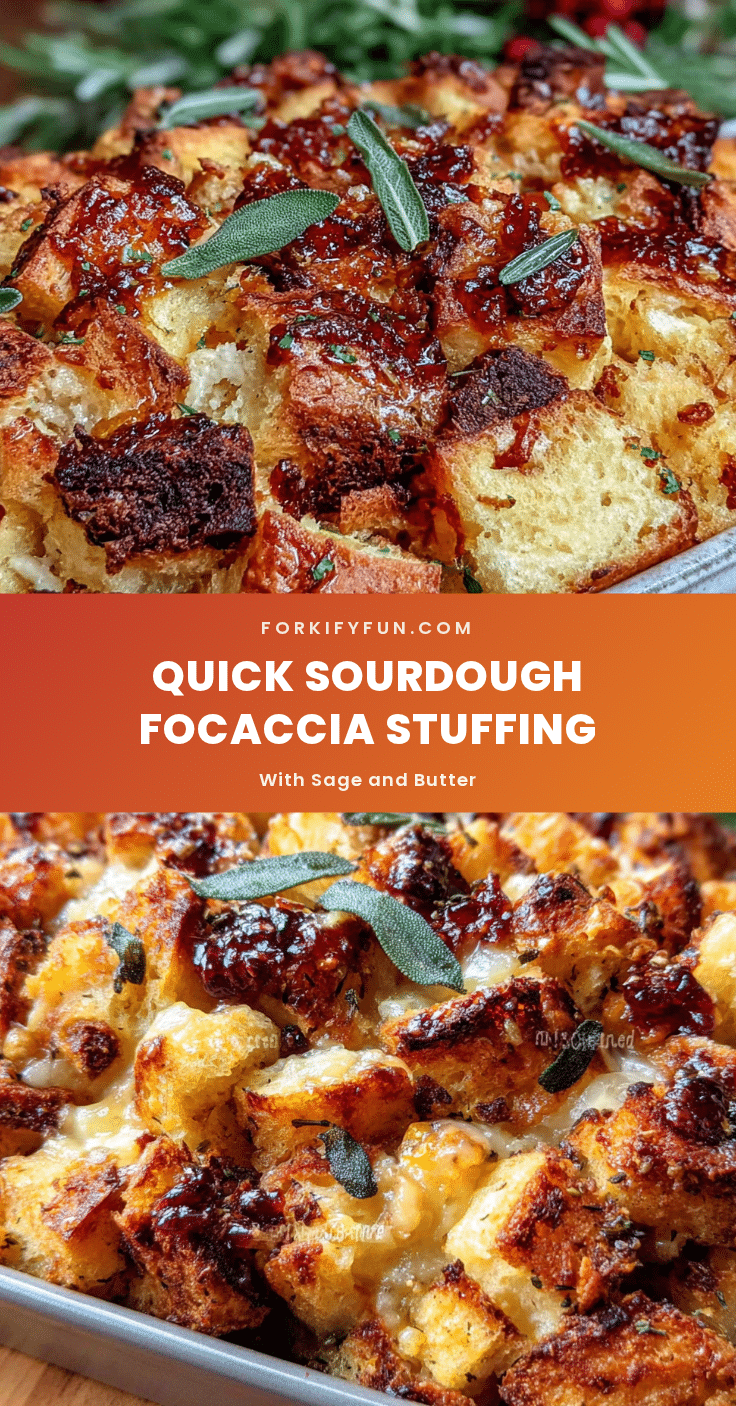
Easy Quick Sourdough Focaccia Stuffing with Sage & Butter

A quick and easy stuffing made with tangy sourdough focaccia, fresh sage, and butter. Perfect for weeknight dinners or holiday feasts, this recipe comes together in under 40 minutes with simple ingredients.
- Prep Time: 15 minutes
- Cook Time: 35 minutes
- Total Time: 50 minutes
- Yield: 8 servings 1x
- Category: Side Dish
- Cuisine: American
Ingredients
- 1 pound sourdough focaccia, cut into 1-inch cubes (about 4 cups)
- 6 tablespoons unsalted butter, divided
- 2 tablespoons fresh sage leaves, chopped
- 1 medium yellow onion, diced (about 1 cup)
- 3 celery stalks, diced (about 1 cup)
- 3 garlic cloves, minced
- 1 ½ cups low-sodium chicken or vegetable broth
- 2 large eggs, lightly beaten
- 1 teaspoon kosher salt (use ½ teaspoon if using table salt)
- ½ teaspoon freshly ground black pepper
- 2 tablespoons fresh parsley, chopped (for garnish, optional)
Instructions
- Preheat oven to 375°F (190°C). Position a rack in the middle.
- Spread focaccia cubes in a single layer on a baking sheet. Bake for 8-10 minutes until lightly golden and dry. Set aside to cool.
- Melt 4 tablespoons butter in a large skillet over medium heat. Add diced onion and celery. Cook for 6-8 minutes, stirring occasionally, until onions are translucent and celery is softened.
- Add minced garlic and chopped sage. Cook for 1 minute, stirring constantly, until fragrant. Do not let garlic brown.
- Transfer vegetable mixture to a large mixing bowl. Add toasted focaccia cubes and toss gently to combine.
- In a separate small bowl, whisk together broth, beaten eggs, salt, and pepper. Pour over bread and vegetables. Fold gently until bread absorbs liquid.
- Let mixture sit for 5-10 minutes, stirring once halfway through. Bread should be moist but not swimming in liquid.
- Transfer to a 9×13-inch baking dish and spread into an even layer. Do not press down firmly.
- Melt remaining 2 tablespoons butter and drizzle over the top.
- Cover with aluminum foil and bake for 20 minutes. Remove foil and bake for another 15-20 minutes until top is golden brown and crispy. Internal temperature should reach 165°F (74°C).
- Let rest for 5 minutes before serving. Sprinkle with fresh parsley if desired.
Notes
Toast bread cubes even if they seem dry to prevent soggy stuffing. Let mixture rest before baking to allow bread to absorb liquid. For make-ahead, assemble without butter drizzle up to 24 hours in advance and refrigerate; add butter and add 10 minutes to covered baking time. For extra crispy top, broil for 1-2 minutes at the end, watching carefully.
Nutrition
- Serving Size: 1 cup
- Calories: 285
- Sugar: 3
- Sodium: 520
- Fat: 14
- Saturated Fat: 8
- Carbohydrates: 32
- Fiber: 2
- Protein: 7
Keywords: sourdough focaccia stuffing, sage butter stuffing, quick stuffing, easy stuffing, weeknight stuffing, holiday stuffing, sourdough stuffing